
MCAS
Reacting to foods, smells, and weather that never used to bother you?
Flushing, hives, and a racing heart out of nowhere. New sensitivities to foods, scents, and medications. A gut that reacts to everything while the allergist says your tests are normal. When mast cells misfire, the whole body reacts, and standard allergy testing keeps missing it.

Start here
This is the place to start. In conversation with Dr. Lawrence Afrin, one of the world's leading mast cell experts, Aaron lays out why MCAS is the ultimate imitator, how one overreacting system can hit skin, gut, heart, and brain at once, and why it may be the common thread running through the whole Pentad. If MCAS is new to you, read this first.
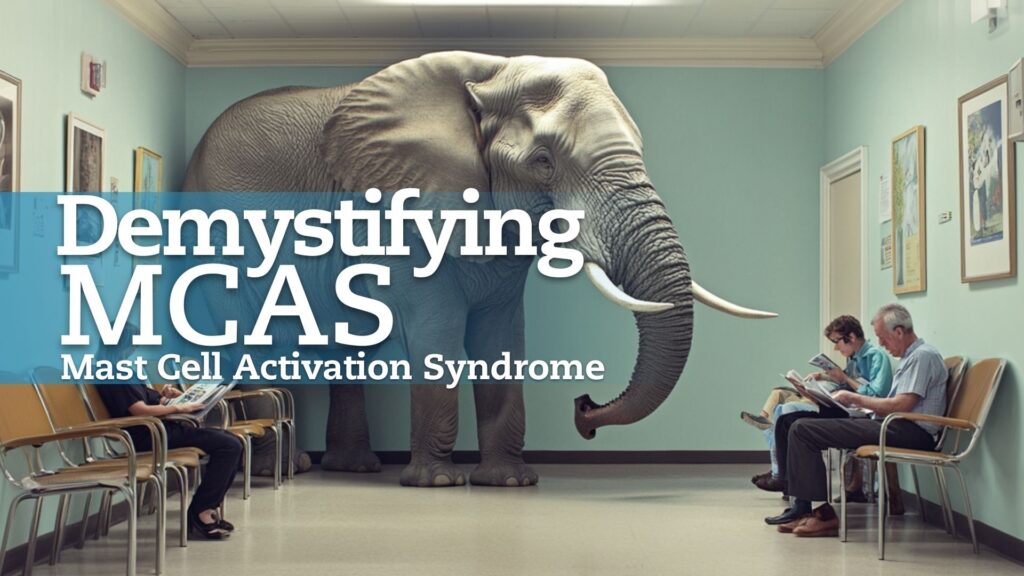
Demystifying Mast Cell Activation Syndrome (MCAS)
If ever there were an 8,000-pound invisible elephant in the medical profession’s waiting room, it’s this disease.
What mast cells do when they misfire
Mast cells are the immune system’s first responders. They sit in nearly every tissue in the body, loaded with histamine and other chemicals they release to defend you. In MCAS they release those chemicals at the wrong times, in response to things that were never actually a threat.
Because mast cells are everywhere, the reactions show up everywhere at once: skin, gut, heart, brain, airways. That is why MCAS looks like many separate problems and rarely fits inside one specialist’s box. It also tends to travel with hypermobility and POTS, which is why these three so often appear in the same person.
What patients describe
- Flushing or hives
- Racing heart
- New food or chemical sensitivities
- GI reactions
- Brain fog
- Anxiety
- Headaches
- Reactions to heat or exercise
200+
different chemical mediators are released by mast cells, which is why one misfiring cell type can look like a dozen conditions at once.
Everything else on MCAS
Browse our library of articles on MCAS and everything connected to it.















Could mast cells be behind your reactions?
Take the ConnectCODE Self Assessment to see how MCAS connects to hypermobility, POTS, and the rest of your picture.