
Why Hypermobility Makes You Anxious
Your anxiety may start in your connective tissue

Aaron Hartman MD
August 26, 2026

Subscribe
Never miss out on new content from Dr. Hartman.
You’re sitting down relaxing with your spouse. The TV’s on. It’s quiet. And you still don’t feel at ease.

That’s the anxiety I want to talk about. Not panic. An internal sense of fear, dread, uneasiness, angst, with nothing attached to it. If someone asked what was wrong, you’d have nothing to hand them.
It can be mild, moderate, or severe. Most of the people I see land in the mild to moderate range, which is its own kind of trap. You get through the day, you do your stuff, you just aren’t right. And it’s been going on for months (even years) … not days.
Maybe you’ve been told to relax. Maybe you’ve been handed a prescription that took the edges off and never touched the rest.
That feeling may have much less to do with your thoughts than anyone has told you.
The August I couldn’t stand the sound of my own family

In August 2021 I got COVID, and what followed was about six weeks of pretty bad anxiety. The voice of my wife put me on edge. The voice of my kids put me on edge. The dog running through the house put me on edge. Nothing in my life had changed. I got a taste firsthand of what this kind of anxiety feels like.
My trigger was a virus. What I want to talk about here starts somewhere else, in connective tissue. But the experience is the same either way: anxiety with a physical cause feels, from the inside, exactly like anxiety caused by your life. You can’t tell them apart by how they feel.
I’ll come back to what I did about it.
Hypermobility & anxiety: what’s happening in the tissue

If you’ve never heard the word hypermobility applied to you, the short version is this. Connective tissue is the material that holds you together, and in some people it’s built a little looser than standard. Joints travel farther than they should. Ligaments give where they’re supposed to hold, and the skin is often soft or unusually stretchy. It runs in families and it’s far more common than most physicians realize. It also sits at the center of a cluster of conditions I’ve written about at length in our guide to hypermobility spectrum disorder and in The Pentad Supersyndrome.
Most people picture hypermobility as a joint problem. Loose joints, sore joints, the occasional subluxation (popping or partial dislocation). That framing misses the part that matters most for anxiety.
Here’s the part that gets missed: Your connective tissues are packed full of nerve endings. That tissue is wired.
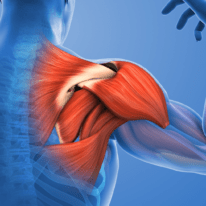
Put those two together. Tissue that’s looser than it should be doesn’t hold position well, so the structures it stabilizes move slightly past where they belong, thousands of times a day. Every reach, every stair, every hour in a desk chair. What that produces is a steady stream of micro-tears. Tiny ones. You wouldn’t feel them as an injury and they don’t show on imaging.
But the nerve endings in that tissue register every single tear. And the signal they send upstream is a damage signal.
Your body responds to these damage signals the way it always responds to a damage signal. It releases cortisol and adrenaline. Small doses, nothing dramatic, nothing you’d notice as an event. The problem is that it happens again a few minutes later, and again after that, all day long, for years. Those low-grade cortisol and adrenaline spikes come, in the plainest terms I know, just from living, just from sitting and moving because of the looseness.

The way I describe it to patients is that you’re always feeling kind of jazzed. Wired without a reason to be wired. It’s also why hypermobile people so often have a quicker startle response. The system is already partway up the hill before anything happens.
In hypermobile people, the stress hormone system can run elevated all day without a single stressful event taking place. No thought is driving it and no unprocessed grief is driving it. Your tissue is generating an alarm signal, and your brain is doing exactly what it’s built to do with one. This is physical stress in the most literal sense, and it’s the category patients almost never think to count.
Which means that when you sit in a quiet room with your family and feel like something is wrong, your body is telling you something is wrong. It’s just wrong about where.
The loop: cortisol makes connective tissue looser
That would be bad enough on its own, but the traffic also runs the other direction.

Short-term cortisol is fine. It’s a stress hormone, it’s supposed to spike, that’s the job. High doses of cortisol over time are a different matter, because sustained cortisol is actually toxic to tissues. Prolonged exposure suppresses the synthesis of type I and type III collagen, which is the structural protein your connective tissue is built from.1 Kept up long enough, that makes your connective tissues a little looser.2 That’s the loop closing.
Loose tissue drives cortisol up. Elevated cortisol degrades tissue further, which makes it looser. Looser tissue tears more, which drives cortisol higher still. Round and round, on a timescale of years, quietly, while you get told to manage your stress better.
This is a mechanism, not a verdict on your particular body. But if you’ve wondered why your symptoms got worse over a decade instead of holding steady, or why the stress-reduction advice you were given did so little, the loop is a reasonable place to look. Advice aimed at your thoughts has a hard time reaching a process that isn’t running on thoughts. Sustained cortisol also wears on the hippocampus, which is part of why memory goes along with everything else.3 If you want the full picture on what this hormone does when it stays up, I’ve written about cortisol, the king of all hormones.
Hypermobility, the nervous system, and three regions of the brain
Cortisol and adrenaline hit specific regions of the brain, and each region produces a symptom you’d describe in completely different language.
The prefrontal cortex: the thoughts that won’t stop circling
The prefrontal cortex is the higher part of your brain, and its job is planning and executive function. It’s what lets you follow a recipe, plan a vacation, or hold six steps in your head at once and put them in the right order. It’s also what lets you think usefully about the future and reflect on the past.

Under sustained stress hormone load, it does two things:
-
It ruminates. Thoughts go around the same track without arriving anywhere (most reliably at 2 in the morning).
-
It loses the tasking. You know exactly what you need to do, you can see the whole task, and you cannot get the steps to line up. People call this laziness. Or procrastination, or brain fog, and most of them apologize to me when they describe it. What’s happening is that a region of the brain is being asked to run executive tasks in a chemical environment that won’t support them.
The distinction has practical consequences. If the stall is a character flaw, the remedy is discipline, and by the time people reach my office they’ve usually been applying discipline to it for years. If the stall is chemical, discipline is the wrong tool, and no amount of it is going to finish the job.
The amygdala: everything gets louder
The amygdala is the seat of your emotional memory, and it sets emotional amplitude. Think of it as the volume knob on feeling.

In 2012, Eccles and colleagues published a study in the British Journal of Psychiatry comparing brain structure in hypermobile and non-hypermobile people. They found a bilateral difference in amygdala volume that distinguished the two groups, with an effect size comparable to or greater than what you see in volumetric studies of clinical psychiatric populations.4 A follow-up from the same group, published in the same journal in 2025, moved from volume to reactivity. Using functional MRI while participants looked at emotional faces, they found that hypermobile people who also had generalized anxiety disorder showed amplified activity in the left amygdala, which handles threat, and the mid insula, which maps the state of your body. Among the anxious participants, the more hypermobile someone was, the busier the anterior insula, the region that ties what your body is doing to what you feel about it.5

The same study found decreased volume in the anterior cingulate and parietal regions, and the hypermobile participants weren’t significantly more anxious than the comparison group. What they were was more interoceptive, which is to say more sensitive to their own internal signals.
The study doesn’t show that hypermobility causes anxiety. What it points to is a structural predisposition paired with a nervous system that’s turned up on internal signal. In other words, your hardware may be tuned to notice what’s happening inside your body more acutely than most people’s.
In the clinic, what that looks like is a bigger seat for emotional memory and more emotional bandwidth. When something happens, you don’t get a small change in mood. You get a big one. Now put that amplitude together with a tissue-level alarm running all day. That combination explains a great deal.
The brainstem and the vagus nerve
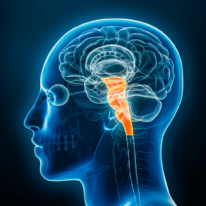
The third region is the brainstem, where the vagus nerve originates and where the autonomic nervous system runs the machinery you don’t think about: heart rate, blood pressure, digestion, the shift between fight-or-flight and rest-and-digest.
This is a large enough subject that it has its own article. If your symptom picture includes racing heart on standing, lightheadedness, temperature dysregulation, or digestive trouble, that’s where you want to go next. Hypermobility and chronic health issues covers dysautonomia, POTS, and the vagus nerve properly.
Why this so often gets called something else
Here’s where a lot of people get lost in the medical system for a decade.
Take a nervous system with a wide emotional amplitude, add years of chronic stress-hormone exposure, and watch what it looks like from the outside. Big feelings that arrive fast. Reactions that seem out of proportion to what caused them. Good stretches and bad stretches. Relationships that feel intense from the inside and look volatile from the outside.

Now imagine describing that to a clinician in a fifteen-minute appointment. What gets written down is a mood disorder. Emotional fluctuation in hypermobile patients gets misdiagnosed as bipolar disorder or as a personality issue often enough that I’ve stopped being surprised by it. Often what’s actually there is fluctuating emotion in a nervous system built with a wider range, worn down by years of stress hormone load, and nobody in the room ever asked whether the joints were loose. Anxiety, depression, and bipolar disorder are all more common in hypermobile people than in the general population. For anxiety, a meta-analysis of fourteen studies put the odds at better than four to one.6 That should make the joints an early question rather than one nobody ever gets around to.
If you’ve been on the receiving end of that appointment, you already know the feeling, and I’ve written about it directly in medical gaslighting.
Let me be careful here. Your diagnosis may well be right, and if you’re on a medication, that conversation belongs with the physician who prescribed it. My point is narrower. Emotional amplitude has more than one possible source, and connective tissue is a source that almost never gets checked. For some patients, treating the physiology underneath brings the amplitude down enough to surprise everyone in the room.
Emotional amplitude has more than one possible source, and connective tissue is a source that almost never gets checked. For some patients, treating the physiology underneath brings the amplitude down enough to surprise everyone in the room.
The company this anxiety keeps
Anxiety driven by this mechanism rarely shows up alone. It travels with what I call the terrible triad: fatigue, non-restorative sleep, and impaired concentration. It’s the hallmark pattern I see in mold patients, in Lyme patients, and in hypermobile patients. Three different front doors into the same machinery.

Patients usually come in for whichever of the three is loudest that month, and the other two only surface when I ask.
A couple of years ago I started seeing a young woman in her twenties. She came in for brain fog, anxiety, gut issues, and trouble staying focused. She wasn’t feeling good and she couldn’t tell me which problem was the main one, because from the inside it was all one problem. Working through it, we found she was hypermobile, along with some nutrient deficiencies nobody had checked. I ended up seeing her mother too. That part surprises people less than it should, given that this runs in families.

The same goes for the rest of the picture. I almost never see a patient with long-standing gut issues who doesn’t also carry anxiety or depression. The mold patients have it. The Lyme patients have it. Once you’ve seen enough of these people you stop treating the anxiety as a separate complaint that happens to be in the chart.
The three feed each other so tightly it’s usually pointless to argue about which came first. Fatigue makes concentration worse. Poor concentration makes everything take longer, which costs you sleep. Poor sleep deepens the fatigue. And the whole cluster runs on the same underlying stress-hormone load we’ve been talking about.
Sleep fails in more than one place. Falling asleep should take 5–10 minutes. Staying asleep is a separate job, and it’s the one this mechanism tends to break: you go down fine and then come apart in the second half of the night, awake at 2 or 3 am, sometimes with the heart going, sometimes wide awake for no reason you can name. Overnight cortisol and adrenaline spikes are a well-described driver of that pattern, and they connect to the autonomic side of hypermobility, which I’ve covered in hypermobility and chronic health issues. For the practical side, the environment and routine changes that make the biggest difference, start with 8 lifehacks for better sleep. There’s more to say about which part of your sleep is failing and what each failure points to, and I’ll be writing about that separately.
Where to start
If the mechanism runs the way I’ve described, the intervention has to reach the nervous system itself.
The first thing I reach for is breathwork.

Before you throw up your hands or bounce … I know how that lands. When you’ve spent years being told your problem is stress, a physician saying “breathing exercises” can sound like the same dismissal wearing a lab coat. So here’s the reasoning: Everything your autonomic nervous system does, it does without you: your heart beats, your gut digests, your blood pressure holds, and you never think about any of it. Breathing is the one exception. You don’t have to think about it either, but you can take it over with your conscious mind whenever you want. That makes a rhythmic breathing practice a door into a system you otherwise have no handle on.
Two things about the timeline, because people quit before they get there. At first it won’t feel like it’s doing much. It takes about 2–4 weeks of daily work before you notice your baseline anxiety come down and before your body starts responding to the breath the way it would respond to a medication. We call these “practices” because you have to practice them. Doing it once doesn’t count.
I’m not going to teach you the protocol here, because we’ve already covered it properly elsewhere. Breathwork for stress relief walks through eight techniques and the science underneath them. Start with box breathing. It’s the simplest one and it’s where I start most patients.
This is also the answer to what I left hanging earlier. After COVID, I knew the anxiety meant my brain was inflamed and I didn’t want it to stick, so I did breathwork, twenty minutes twice a day. The first week was torture and my mind went everywhere. By the end of six weeks the anxiety was broken. I’ve written about that stretch, and about what changed my mind on breathwork in the first place, in how breathwork broke my wife’s trauma cycle.
There’s a reason I didn’t wait it out. The post-COVID patients who left their anxiety alone were often still carrying it a year later, and by then it had laid down new pathways that were much harder to undo. An alarm signal that’s been running a long time gets harder to interrupt. That’s an argument for starting this week rather than after you’ve read three more articles.
Whether this mechanism is yours

All of that is a mechanism. What it can’t tell you is whether this is your mechanism. An article doesn’t know your joints, your history, or which of the pieces above apply to you.
That’s what the ConnectCODE quiz is built for. It walks through the connective tissue picture and the symptom clusters that travel with it, then returns a hypothesis report built on your answers, with sub-scores for the anxiety and brain fog patterns described in this article. Takes a few minutes. It’s free.
If you’ve been carrying an anxiety you can’t explain, and nobody has ever looked at your connective tissue, this is the place to find out whether that’s the thread worth pulling.
You were made for health. Sometimes the first step is finding out what’s actually in the way.
Aaron Hartman, MD