
On a GLP-1? Feed Your Gut, Not Just Your Muscle
Eating less on a GLP-1 can starve the gut bacteria that make your body's own GLP-1 (and they don't live on protein shakes).

Aaron Hartman MD
October 14, 2026
Subscribe
Never miss out on new content from Dr. Hartman.
About three years ago, one of my patients came in and said, “Hey, I heard about this thing.” The thing was microdosing GLP-1s, something they’d read about on a blog. I’ve been using GLP-1s in my practice since about 2005 or ’06, and my first reaction was, “That’s the dumbest thing ever. Who’s gonna do that? Sure, whatever, we’ll try it.”
Then microdosing started showing up in the mast cell world. People were reporting it helped POTS, dysautonomia, chronic fatigue, fibromyalgia. Over the last two years I’ve seen some pretty crazy responses, and I’ve written about those patients before.
The group I want to talk about here is women going through perimenopause and menopause, particularly the type A women I see in my practice, the ones who go, go, go. “I’m sleeping five hours a night. I’m running this business, I’ve got the kids.” Then they crash out. When I start replacing their hormones it’s really hard, because underneath the sex hormones (estrogen, progesterone, testosterone) I’m dealing with cortisol. I wrote about that layer of stress physiology earlier this year.
In that group of women, GLP-1s have been this crazy tonic. I theorize it’s the mast cells and the inflammation. But I’ll be honest: I don’t yet fully understand what it’s doing.

So when I sat down with Dr. Julia Malkowski, I put a pin in it and asked her. Julia is a naturopathic doctor and chiropractor with a background in biomedical science. She’s a clinical educator at Doctor’s Data and runs her own functional medicine practice outside Chicago. Her research and international teaching focus on the gut microbiome.
Her answer started with the fact that your gut makes its own GLP-1. It ended with a warning that’s missing from most of the GLP-1 nutrition advice I see, including what I’ve written here before.
GLP-1 & Gut Health: Your Gut Already Makes GLP-1
GLP-1 stands for glucagon-like peptide-1. Long before it came in an injection pen, your gut was making it every day. Here’s how Julia described it:
“GLP-1 is glucagon-like peptide, and it is actually secreted from the gut microbiome in the presence of specific bacteria, including Akkermansia and Bifidobacterium, under the conditions of colonic distension. So when we feed our colon properly and we have adequate fiber, especially soluble and insoluble fiber, that combination there, it signals our intestinal cells to expand and distend.” [1]
In plain terms: fiber fills and stretches your colon. Stretch sensors in the gut wall and the right bacteria work together to tell your body that real food has arrived. GLP-1 gets released, travels to the hypothalamus, turns hunger down and fullness up, and helps manage insulin.
Then Julia gave me a set of numbers: The GLP-1 your gut makes has a half-life of about two minutes. The pharmaceutical version has a half-life of about one week. [2]
So the version your body makes is a short pulse after a meal, and the drug is a signal that never switches off.
Deficient, or Overridden?
That raises a question neither of us could fully answer. Julia put it this way: “Are we deficient in this peptide as a population? Or is this associated with some changes that we’re observing with the gut microbiome?”

I came at it from the dosing side. When I was going through my certification in personalized medicine at USF, one of the lectures showed that GLP-1s dosed pharmacologically run about 10–15 times our physiologic levels. [3] Even with microdosing, you’re still getting a supraphysiologic dose. So is the drug correcting a deficiency, or overriding a resistance? And long term, does it abdicate our need to do all these other things?
Julia’s view is that the drug benefits physiology, especially at microdoses, and that the dose matters. She also theorizes that moderating those constant glucose and insulin swings over years is part of why we’re seeing lower rates of dementia and cardiovascular disease in these patients. [4]
I don’t think the deficiency question is settled.
What to Eat on a GLP-1: Your Gut Bacteria Need Feeding Too
If you’ve been on a GLP-1 for more than a week, someone has told you to eat your protein. I’ve said it myself: protect your muscle, lift something heavy. That’s still good advice, but Julia’s point is that it’s incomplete.
“There’s a lot of education about feeding protein to support muscle during your GLP-1 journey. But I do strongly advocate to feed your gut microbiome during the GLP-1 journey, because what will happen is if patients aren’t eating and they’re deficient in fiber, they’re deficient in polyphenols. What will happen is starvation of beneficial bacteria like Akkermansia and Bifido and Lactobacillus.”

Once those bacteria starve, they die off. The microbiome shifts toward dysbiosis and loses diversity. That kind of microbiome is pro-inflammatory. In her words, “You don’t wanna be counteracting that anti-inflammatory GLP-1 with an inflammatory state in the microbiome.”
Akkermansia and Bifidobacterium are two of the species that trigger your own GLP-1 release. So a drug that cuts your appetite can, if you let it, starve the bacteria that make the body’s version of the same signal.
For the perimenopausal women I described at the start, that matters twice. If calming inflammation is part of why GLP-1s help you, an inflamed, starving microbiome is working against the reason you’re on it.
The second reason is timing. Julia sees perimenopause as one of the key windows for the gut. The first is early childhood, when the microbiome is being seeded. The second is this transition, and what you feed your gut now shapes how it serves you for the next decade.
Your Plate Decides Which Way It Goes
The drug itself may even help. Julia was clear that there’s some evidence GLP-1 benefits the microbiome, particularly Akkermansia muciniphila. [5] But she added a qualifier: “In reviewing many, many gut microbiomes under the influence of GLP-1, it’s diet dependent.”
Same drug, same dose. One patient’s gut gets healthier and another’s gets worse. The difference is what’s on your plate.
What “Feeding Your Gut” Actually Means
When I say “feed your gut bacteria,” a lot of people hear “take a probiotic.” I understand why, but think about the math. You’ve got something like 100 trillion bacteria in there, and I’m gonna give you a fancy probiotic with maybe five bacteria in it. Even when people feel better, that never quite made sense to me until I understood keystone species.
Julia explained it with an orchestra:
“Not all bacteria are created equal. If you think of them as a symphony, you need all of the instruments playing, but some of them are contributing greater than maybe the tambourine in the background.”


The keystone players she named are Bifidobacterium, Lactobacillus, Faecalibacterium prausnitzii, and Akkermansia muciniphila. Akkermansia isn’t as abundant as the others, but it “kind of punches over its weight” because of its role in the mucosal barrier, the protective layer lining your gut.
Here’s what she told me each one needs:
| Keystone bacteria | What feeds it | Available as a probiotic? |
|---|---|---|
| Bifidobacterium | Polyphenols | Yes |
| Lactobacillus | Polyphenols | Yes |
| Faecalibacterium prausnitzii | Soluble fiber | No |
| Akkermansia muciniphila | Short-chain fatty acids made when Bifidobacterium ferments your food | Newly available |
That third row settles the question. Faecalibacterium is one of the keystones, and there’s no capsule for it. The only way to support it is to feed it.
The last row matters too. These bacteria work in concert, so when you support Bifidobacterium, you’re also feeding Akkermansia.
“Greens, Beans, and Berries”
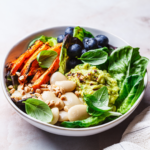
At that point I had to stop and ask the obvious question. Okay, great: we’re all dysbiotic, we’re all gonna die. So what does the average person actually do? Julia’s answer was simple: “Greens, beans, and berries. Very simple, natural diet, traditional diet to support the gut microbiome. Nothing too crazy.”
That covers the soluble and insoluble fiber that stretches your colon and triggers GLP-1, plus the polyphenols your Bifidobacterium and Lactobacillus live on. In perimenopause, that fiber does one more job. This is when Julia sees LDL rise, HDL drop, and oxidized LDL climb, and the fiber that feeds your microbiome helps balance cholesterol. She also singled out olive oil, which improves microbiome diversity, supports the tight junctions in your gut lining, and calms inflammation in the colon. (I actually make mayonnaise out of olive oil sometimes. Olive oil is one of those superfoods that’s amazing in what it does.)
Two non-food levers came up as well: exercise improves microbiome diversity, and so does spending time with other people and outdoors.
The Problem With “Healthy” Processed Food
When your appetite drops on a GLP-1, the easiest way to hit a protein target is a shake or a bar. Read the labels on a lot of them and you’ll find emulsifiers and artificial sweeteners. Julia was blunt about both: “Emulsifiers and artificial sweeteners, those actually cause intestinal barrier dysfunction.”
Years ago, when I was researching this, I found that certain bread conditioners and emulsifiers are associated with inflammatory bowel disease (IBD). [8] And the emulsifier thing is everywhere. It’s hard to find a packaged, boxed food that doesn’t have some kind of emulsifier in it.
What I’m excited about is using food like a drug, then using supplements to superpower it. We did that with all of our kids. My son’s eczema and horrible asthma went away after six months of just changing his diet.
This is why I keep coming back to REAL Food over processed food, even the processed food marketed as healthy. A product can solve one problem, like a protein target, and quietly create another in the gut you’re trying to protect. Julia put the answer in one line: “We have to basically eat whole foods, eat real foods, and focus on feeding the gut microbiome.”
Why Probiotics Can Make You Feel Worse
So where do probiotics fit? Later than most people think.
A lot of my patients, mostly my SIBO patients, my sicker patients, will react. I give them a probiotic and they have a horrible response to it. I asked Julia why.
“That can happen if there is mucosal barrier integrity issues. So if the mucosal barrier is not intact when you add the probiotic in, it’s essentially an exogenous substance. And so there’s a little bit of an immune reaction there, a little bit of irritation and reaction. That’s why it’s really important to actually restore mucosal barrier primarily.”

Sometimes yeast is part of it, she said. But more often than not, it’s the barrier.
That answer fits what I see. In the SIBO world, people will tell you it’s purely a mast cell issue, or purely this or that. But almost all of these patients have mucosal barrier issues, and if you don’t address the barrier, adding bacteria can cause problems.
Julia pointed out that intestinal barrier dysfunction increases as we age, and it increases with stress. “Who amongst us is not stressed and aging, right?” A high-achieving woman in perimenopause, running on five hours of sleep, is the person whose gut lining may not be ready for a probiotic. Falling estrogen loosens that lining too, something I dug into with Cynthia Thurlow.
Barrier First, Then Bacteria
Julia’s order is clear. Before probiotics, she builds the foundation with two things:
- Optimal vitamin D supports the gut barrier and microbial diversity.
- Turmeric is anti-inflammatory and supports both as well.
Only then does she think about probiotics:
“You can’t introduce probiotics without having a secure and protected intestinal mucosal barrier. If you put probiotics in first, you run the risk of irritating the system and actually creating downstream sequelae.”
When the lining needs more help than food and vitamin D can give, I use oral peptides, BPC-157 together with KPV, in my mast cell and food-reactivity patients. KPV even acts as an antimicrobial peptide. It helps balance the microbiome while the tight junctions heal. I have a Crohn’s patient right now who’s in 100% remission, and only recently did I learn that BPC-157 has been through clinical trials for inflammatory bowel disease, the group of conditions Crohn’s belongs to. [9] I’ve written more about how I use BPC-157 for gut repair.
The Motility Question
GLP-1s slow digestion. That’s part of how they work: the stomach empties more slowly, and the small intestine moves more slowly too. [6] They also quiet the migrating motor complex, the housekeeping wave that sweeps the small intestine between meals and keeps bacteria from settling where they don’t belong.
Slowed movement through the small intestine is a known setup for SIBO. Whether GLP-1s actually cause SIBO hasn’t been shown. Large safety reviews don’t list it, and the drug’s own bloating and nausea overlap heavily with SIBO symptoms. [7] But if you’re on a GLP-1 and develop new bloating or diarrhea that doesn’t settle, it’s worth raising with your doctor. And since my SIBO patients are the ones who most often react badly to probiotics, it’s one more reason to get the barrier right before adding bacteria.
Keep Pushing the Boulder
I’ve watched this happen with patients … and with myself if I’m being honest. I’ll run a microbiome test, and it shows low diversity, no Akkermansia, whatever the markers are. I start doing things, they feel better, and then I test again and it doesn’t look that much more amazing.
The way I’ve come to think about it, that first test shows your baseline. If you do nothing, the gut goes back to that. Improving it is like pushing a boulder uphill, and to keep it going up, you have to keep pushing.
Acute problems like a pathogen or a fungal infection are fairly straightforward to fix. The underlying composition of the microbiome takes longer to change, and it tends to drift back toward where it started.
I’ll admit I’m the same way. I’m usually not testing when I feel great. It’s when I’ve fallen off the bandwagon, and sure enough, it looks the same.
The drug changes your appetite for as long as you take it, and some people take it for years. Feeding the bacteria that make your own GLP-1 has to last at least that long. The day you stop pushing, the boulder rolls back down.
If you want help keeping that boulder moving, Made for Health is where I share what I’m seeing in practice and the research behind it, including how to make real food work when life gets busy.
Explore more on these topics
GLP-1 & Weight Loss · Gut Health · Hormones
Notes
- GLP-1 is released by L-cells in the intestinal lining. Gut bacteria influence that release, largely through metabolites like short-chain fatty acids, rather than secreting GLP-1 themselves (Crosstalk between glucagon-like peptide 1 and gut microbiota in metabolic diseases). Dr. Malkowski’s wording is kept as spoken.
- Native GLP-1 is broken down by the enzyme DPP-4, giving it a circulating half-life under two minutes (Ahrén & Schmitz, Hormone and Metabolic Research, 2004). Semaglutide’s half-life in humans is about 165 hours, roughly one week (Lau et al., Journal of Medicinal Chemistry, 2015).
- Figure as cited by Dr. Hartman from his personalized medicine coursework at USF. The ratio varies by drug, dose, and how physiologic levels are measured.
- The SELECT trial found semaglutide reduced major cardiovascular events in adults with heart disease and obesity (Lincoff et al., New England Journal of Medicine, 2023). The dementia evidence is mixed: observational studies show associations, but the Phase 3 EVOKE and EVOKE+ trials of oral semaglutide in early Alzheimer’s disease did not slow progression (Alzheimer Europe, December 2025).
- A 2026 systematic review found GLP-1 drugs shift the gut microbiota toward Bacteroidetes, Akkermansia muciniphila, and Lactobacillus in people with type 2 diabetes (Santos Dantas et al., The FEBS Journal, 2026). A broader review of 38 animal and human studies concluded the effects remain uncertain (Effects of GLP-1 Analogues and Agonists on the Gut Microbiota: A Systematic Review).
- GLP-1 drugs slow both gastric emptying and small intestine motility (Jalleh et al., Journal of Clinical Endocrinology and Metabolism, 2024). A 2025 wireless motility capsule study describes reduced migrating motor complex activity in the small bowel (Impact of GLP-1 Receptor Agonists on Whole-Gut Gastrointestinal Motility).
- Delayed small intestinal transit, more than delayed gastric emptying, is associated with SIBO (Calderon et al., Digestive Diseases and Sciences, 2021). A meta-analysis of 55 randomized trials found GLP-1 drugs raised the risk of gallstones and reflux but had little or no effect on other gastrointestinal events, and SIBO was not among the signals (Chiang et al., Gastroenterology, 2025).
- In mice, two common food emulsifiers, carboxymethylcellulose and polysorbate-80, thinned the protective mucus layer, altered the microbiota, and promoted colitis (Chassaing et al., Nature, 2015).
- BPC-157, under the development code PL 14736, was tested in Phase II clinical trials for inflammatory bowel disease (Sikiric et al., Current Medicinal Chemistry, 2012).