
Perimenopause Is a Litmus Test.
Why Midlife Often Exposes the Physiological Load Women Have Been Carrying for Decades

Aaron Hartman MD
May 13, 2026

Subscribe
Never miss out on new content from Dr. Hartman.
“Perimenopause is a litmus test.”
Cynthia Thurlow said this early in our conversation. She’s a nurse practitioner, host of the Everyday Wellness podcast, and author of the new book The Menopause Gut, and she didn’t stop at the headline.

“Adaptive patterns that we learned as teens, twenties and thirties, suddenly become maladaptive with that decline in hormones. I know plenty of very successful women that got to perimenopause and literally the wheels fall off the bus. They no longer can cope. They struggle with mood. They don’t have the same energy, they don’t have the safety net that those hormones created for them. And so the way they perceive the world changes dynamically.”
In 2018 she and her husband traveled to Morocco, ate the same food, but only one of them came home violently ill. She was 47 and likely in the later stages of perimenopause. The extended illness, the compromised immune response, the months of recovery turned out to be her first real signal that the gut and the hormonal transition were more entangled than the clinical conversation had acknowledged.
The phrase I keep returning to is “safety net.” The conventional framing treats declining estrogen as a deficiency event: the hormones fall, symptoms appear, the goal is replacement. Cynthia is describing something different. The hormones were buffering an accumulated load: chronic stress, poor recovery, sleep debt, gut dysfunction, the overperformance patterns that high-achieving women normalize for decades.
I’ve often called estrogen a superpower. The physiological infrastructure estrogen provides is what allows women to run multiple careers, raise families, absorb chronic stress, and operate on inadequate sleep … without apparent consequence. But those inputs are always accumulating a cost, and eventually the buffering runs out.
The Gut as Resilience Infrastructure
If you’ve subscribed to my newsletter, this won’t be the first time you’ve heard me write about the gut. It really is central to all of health. But Cynthia offers a fresh perspective on how exactly the gut impacts perimenopause and menopause.
Cynthia describes the microbiome as the key longevity organ that no one is thinking about: 40 trillion bacteria, viruses, fungi, and protozoa contained in the large intestine, interfacing with every organ system in the body. There’s a gut-brain axis, a gut-bone axis, a gut-ovarian axis. And all of that changes significantly as hormones decline.
The Estrobolome

The estrobolome is the gut’s estrogen-processing center. Its job is to package up excess estrogen so the body can eliminate it. When the microbiome is disrupted by chronic stress, poor diet, toxin exposure, or antibiotic use, that packaging breaks down. The excess estrogen gets recirculated back into the bloodstream instead of eliminated, and the result is a cluster of symptoms that looks purely hormonal but actually originates in the gut: brain fog, breast tenderness, weight resistance, mood instability.
“A lot of symptoms women experience in perimenopause and menopause are a reflection of the health of the microbiome.”
Estrogen & Leaky Gut

Estrogen acts as the mortar in the brick-and-mortar system of the intestinal lining, and that lining is only one cell layer thick. As estrogen declines, the mortar weakens, tight junctions open, and the barrier that’s supposed to keep gut contents where they belong becomes permeable. We call that “leaky gut.” Endotoxins cross. The immune system responds. Food sensitivities that were previously manageable start getting worse. And the inflammatory signal doesn’t stay local. The vagus nerve runs a constant relay between the gut and the brain.
“If your gut’s inflamed,” Cynthia said, “you’re probably dealing with an inflamed brain.”
What Midlife Removes
“As progesterone is declining, you lose the ability to not feel quite as anxious, not feel quite as depressed, not have the issues with sleep.”

Progesterone supports GABA, the primary inhibitory neurotransmitter. GABA is responsible for calm and rest and the ability to down-regulate after stress. When progesterone falls, that support falls with it. For women who were already running on a sympathetic-dominant nervous system (which describes most of the high-achieving women I see) the shift from managing to not managing can feel sudden even when the underlying decline was gradual.
Estrogen is doing similar work at a different level. It influences serotonin synthesis and dopamine. Its decline is part of why anxiety, depression, and disrupted sleep tend to accelerate together in perimenopause rather than appearing one at a time. Women often describe this phase as feeling like a different person. The neurochemistry shaping perception, mood, and emotional tolerance is shifting.
But Cynthia doesn’t frame all of this as pure malfunction:
“I think we really become the people we are meant to be in middle age, because we are stripped of the people-pleasing tendencies.”
The hormones were holding what was already there. Now they’re holding less. That’s not the same thing as something going wrong.
Major in the Majors

Toward the end of our conversation, I made a comment about how everyone wants the magic fix: the gadget, the panel, the supplement that worked for the last thirty people. Cynthia didn’t disagree, but she pushed back on the direction most people are heading when they go looking for one. She’s watched women spend serious time and money on advanced testing, microbiome analysis, and sophisticated interventions, only to see underwhelming results because the foundational inputs were still unstable.
“Before you even get to those devices, let’s dial in on the basics. Because I find that most women are already overwhelmed.”
Those basics (sleep, stress management, nutrition, and movement) are the starting point because without them, nothing layered on top holds the way it should. Get those basics dialed in first, add a gut protocol or hormone replacement on top of that foundation, and that’s when results become meaningful.

“You have to adjust your lifestyle … You must.”
High-functioning people are remarkably good at tolerating conditions that accumulate a biological cost over time. Disrupted sleep, chronic stress, under-recovery, compromised gut health: the body absorbs these for years, sometimes decades, without apparent consequence. Perimenopause is often the point where that tolerance runs out. The conversation Cynthia and I had wasn’t really about finding the right new intervention. It was about understanding why the body eventually stops compensating, and what it’s trying to tell you when it does.
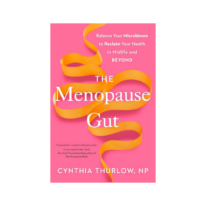
Watch the full conversation with Cynthia on the Made for Health podcast.
Her book, The Menopause Gut, is available now wherever books are sold. It goes significantly deeper into the science behind what we covered here, and it’s worth reading if this conversation opened up questions you want to follow.