
Long COVID
The Problem With Saying “There’s Nothing You Can Do” for Long COVID

Aaron Hartman MD
July 8, 2026
Subscribe
Never miss out on new content from Dr. Hartman.
Most of my Long COVID patients walk in having already been told some version of the same thing: manage your symptoms, wait it out, and we’ll see how you feel in a few months. That’s the message. Rest… pace yourself… come back later.
Here’s what I don’t understand about that message. Christian and I have a list. It’s a long list. It’s a list of things we’ve watched work, in real people, in our own exam rooms, sometimes dramatically. So how is it that patients keep hearing there’s nothing left to try?
The question isn’t “what’s the single best Long COVID treatment,” because I don’t think that question has an answer. The one that keeps nagging at me is this: if there are this many things worth trying, why do so many patients believe there’s nothing?

My colleague Dr. Christian Jenski put it plainly:
“Do your own research, then talk to your provider about it and see what might make sense for your specific case. Worst case, they say no. But at least you tried, and then you can move on to the next person. What you shouldn’t do is sit there thinking you don’t have any options, that you’re destined to a life of suffering. That’s not okay.”
That’s the spirit of this article: A list of the things we’ve actually reached for, and what happened when we did.
Why the toolkit looks so strange
If you go looking for Long COVID treatments, the list you’ll find looks random: An opioid medication at a tiny dose. A diabetes drug. An old allergy compound. A phospholipid infusion. Hyperbaric oxygen. There’s no obvious thread. It looks like a grab bag.
There’s a reason for that. Almost none of it was invented for Long COVID. These are repurposed medications, some of them repurposed herbs, and most of them do more than one thing. That’s what lets us layer them and pick the combination that makes the most sense for the person in front of us.
This is the same instinct that let me recognize these patients early in the first place. I’ve said before that about 80% of what I do for Long COVID now is what I was already doing in March, April, and May of 2020, because I went back to what had worked before for people who stayed sick after an infection. The tools were already on the shelf. We just started reaching for them again.
It also means there’s no tidy one-size protocol, and there never will be. Different patients respond to different things, because Long COVID isn’t one disease. It’s several overlapping problems running at once, and which problems are driving your illness determines what actually helps. Some of the therapies below will be a nothingburger for one person and the thing that gives another person their life back. I’ll flag that as we go, because it matters more than any single item on the list.
The biggest hitter: low-dose naltrexone
If you asked Christian to name the one that’s changed the most for his patients, he doesn’t hesitate. It’s low-dose naltrexone, and it sits at the top of the list for a reason.

Here’s how he explains it:
“Naltrexone is an opiate antagonist. It was studied for the opiate epidemic, as a way to help people control pain without becoming addicted. And in studying it, they found this paradoxical effect nobody expected. You get an upregulation of your own endorphin production, your own natural pain medicine, and along with it this anti-neuroinflammatory, immune-modulatory effect. It just snowballed from there, and now it’s used almost everywhere.”
Patients sometimes don’t believe LDN is doing anything, because it usually isn’t dramatic. Christian describes it as a kind of panacea that never feels like one:
“It’s not a hammer over the head. It’s not night and day where you take it and suddenly everything’s better. A lot of times the question I get is, ‘How do I know it’s working?’ And my answer is always, ‘Let’s stop and see.’ And two weeks later, like clockwork: ‘Hey, can I get back on my LDN?’ Their sleep’s off, their energy’s off, the pain’s back. I guess it was working.”
His favorite version of the story is the autoimmune one. He’ll take a patient who’s been told there’s nothing to do but manage symptoms, or who’s been put on some immune-suppressing drug, and he’ll work the gut, get them gluten-free, put them on LDN, and then just watch the labs. The anti-TPO antibodies come down. The rheumatoid factor comes down. The anti-CCP comes down. He gets to tell them they’re heading toward remission, which he says is about the most satisfying thing he does.
On dosing, I’ll only say what we’ve done, not what you should do, because this is exactly the kind of thing that needs a prescriber who knows your case. Christian tends to build slowly and stays in a fairly standard range. I run a little higher in a specific slice of patients. Naltrexone is actually FDA-approved for weight loss at much higher doses, and I’ve found that a subset of my patients, usually the POTS and dysautonomia folks, the chronic-fatigue-ish hypermobile ones, do better with a bit more. That’s me self-selecting based on years of watching who responds. It’s a safe, therapeutic trial, and the dosing’s already FDA-sanctioned.
Christian’s take on side effects matches mine: they’re mild and usually pass. Some vivid dreams, a little sleep disruption early, occasionally some dizziness or daytime drowsiness that goes away when you drop the dose. In his experience nobody’s had to stop over it.
If you want the fuller picture of how this one little molecule does so much, we’ve written about LDN on its own.
GLP-1s, and why the weight loss isn’t the point
The next one surprises people, because they know it as a weight loss drug. I use GLP-1 medications, tirzepatide especially, as anti-inflammatories.
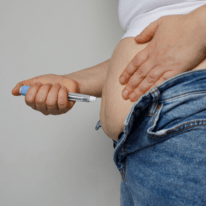
The patients I reach for them with are the super-reactive ones. The Long COVID patient who tells me they react to everything, who rashes up, whose nervous system is running hot. My own wife is a good example. She’ll get exposed to something, break out in hives, get tingling in her mouth. On a microdose of a GLP-1, that’s completely gone.
I dose these low. Not the standard starting dose, more like a fifth of it. And here’s how I know there’s an inflammatory component driving things: when I start someone on a microdose, they’ll drop five or ten pounds. That’s not the weight loss. That’s the anti-inflammatory effect showing up on the scale. When one of my really reactive patients loses a few pounds on a dose that low, that tells me something is calming down.
It’s funny to me, because twenty years ago I was using these same drugs at big doses with my diabetic patients. Now most of what I do is microdosing. Same drug, completely different job.
Christian’s seen his own version of this. He’s reversed fatty liver in two patients on tirzepatide. Different organ, same underlying idea: you’re not chasing a number on the scale, you’re quieting inflammation.
If that reframe is new to you, the weight loss really is the least interesting thing these drugs do.
The mast cell stack
Mast cell activation is one of the threads that runs through so many of these patients, and treating it isn’t one move. As Christian says, it’s not one thing, it’s a stack. You layer.
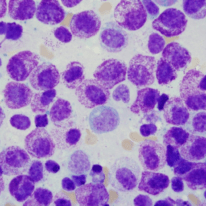
Cromolyn is often where I’ll start, because I had one patient who made me a believer. She had POTS, dysautonomia, and horrible pain, and oral cromolyn made all of it go away. Just went away. Now, I agree with Christian on the reality that most of the time cromolyn is a shrug. “Eh, I don’t notice a difference.” But every so often you get the one magic case where nobody’s tried it yet, you give it, and everything gets better. When that happens, it’s remarkable. It just doesn’t happen every time, and anyone who tells you it does is selling something.
Ketotifen is the one Christian’s whole family is on. It’s a combination mast cell stabilizer and antihistamine, compounded, so it works upstream and down. The catch is that it’s centrally acting and can be a little sedating, so he starts low and slow and has people take it at night. If they wake up fine, not dragging, they keep it at night. He takes it himself. His wife takes it. His daughter takes it. He calls it a game-changer for all three of them, and it’s helped a lot of his Long COVID patients who also had a mast cell picture going on.
A few others live in this same neighborhood. Cyclobenzaprine, which most people think of as a muscle relaxer, is now FDA-approved at a low sublingual dose for fibromyalgia, and it turns out to double as a mast cell stabilizer with some helpful effects on sleep. Clonidine and guaifenesin can be useful for the POTS patient who keeps waking in the middle of the night with their heart racing, that adrenaline-surge feeling that hits the moment they lie down. And when someone’s mind won’t stop spinning at bedtime, Christian likes L-theanine, an amino acid that acts a bit like a low-dose calming agent without any addictive potential. It’s not my first thing or my third thing, but in the right patient it can be surprisingly good. There’s a product I use for the racing-mind-at-night crowd that pairs it with a little GABA.
The point of the stack isn’t to throw all of it at everyone. It’s to have enough tools that you can find the one or two that fit this particular person. If you want to understand the machinery underneath all of this, we sat down with Dr. Lawrence Afrin, the physician who has done more than anyone to map mast cell activation.
Membrane medicine: the oil change
Everybody wants the one ring that rules them all. The single party trick that fixes everything. And if I had to pick something that comes closest, it’s not a drug at all. It’s the cell membrane.
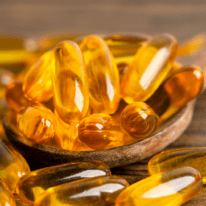
Step back far enough and almost everything we do comes back to this. Every cell in your body, and every mitochondrion inside those cells, is wrapped in a membrane made of fat. When that membrane is healthy, the cell communicates, defends itself, and does its job. When it gets damaged and stiff, none of that works right.
Christian has the best way of describing what goes wrong:
“All the action is at the cell membrane. It’s where the cell communicates, where it defends itself, where it does everything it needs to do to be a cell. Over time, as those membranes get toxic and dysfunctional, these stiff patches form and the membrane stops being fluid. Now it’s stuck. Now the cell doesn’t work, the mitochondria don’t work, and you don’t work. It’s like the oil in your car. Over time it gets rancid, and you have to go get it changed. This is you getting an oil change.”
The workhorses here are the phospholipids, phosphatidylcholine chief among them, along with the right balance of omega-3s and omega-6s. Christian calls phospholipids the unsung hero nobody talks about, and he’s right. You can take them orally, but it’s a real commitment, the scoops rather than a capsule or two, and it costs something in both money and effort. He’ll tell you that’s still the best bang for the buck, and for a lot of patients it is. (This is also where the mitochondria are the one ring that governs your metabolic fate, and why so much of this work comes back to them.)
Then there’s IV phosphatidylcholine, which is where this gets interesting for the patients who are really stuck. Christian and I both think of it like soap. It pulls junk out. In my older patients it acts as a mild blood thinner, and they’ll come in saying they’re thinking more clearly, sleeping better, feeling like they’ve got more in the tank. There was one patient who couldn’t breathe, had seen everybody, had a clean workup top to bottom, and after a couple of IV PC infusions she was breathing better. That wasn’t a coincidence.
IV PC is not a casual thing. There are only one or two places in the world you can even source it properly. It has to be handled a specific way, run slowly, monitored, in the right solution. I’ve had patients go elsewhere and get it done wrong, and done wrong it’s dangerous. This is exactly why these tools need a real clinician standing next to them. 
And then there’s my daughter Anna. People who know my story know Anna, and I won’t go into all of it here. She did about thirty IV PC infusions. Her fine motor control improved to the point where she colors inside the lines now, which she couldn’t do before. And a couple of months ago she looked up and told me she could see stars.
“Hey, Dad, I’m seeing stars.”
I asked her if she’d hit her head. She said no. Then I asked, “Have you never seen these before?” She said, “I just… I can see them now.” Christian’s word for that was the right one. Profound.
The wild cards
The further down the list you go, the more esoteric it gets, and this is where I keep the things I reach for when the usual moves haven’t cracked it.

Antivirals are one. When someone is really showing viral reactivation, high EBV or CMV or HHV6 titers, Christian will sometimes start gentle with lysine or monolaurin, and if that’s not moving the needle he’ll do a real course of an antiviral like valacyclovir. Not seven days. Thirty days, sometimes two months. People come back and tell him the brain fog lifted and their energy’s back, and he can watch the titers fall to confirm it. I tend to hit those cases hard up front and then back off. Either way, it can hold space for a patient while you work on the bigger picture of why those latent viruses got unleashed in the first place. If you’ve never thought about how many of these viruses you might be carrying, the answer is usually more than you’d guess.
Then there’s the story I still can’t quite believe. I had a patient, someone I’d worked with for years, sharp, does her own research. She got acute COVID with respiratory symptoms, so I gave her ivermectin, feeling like the cutting-edge integrative guy. And she started coughing up worms.
Nobody had diagnosed a parasite. Nobody would have thought to. And here’s the part they teach you about in medical school but you almost never actually see: when you kill a big parasite load fast, the die-off can trigger a massive inflammatory reaction that’s genuinely dangerous (the same principle as an old syphilis patient getting penicillin). I remembered that weird factoid at exactly the right moment, told her to stop, and we slowed it way down. It took about three months for her to fully clear it. But she got better, and no one on earth would have found that parasite otherwise.

What I took away from that case is the lesson under all of this: sometimes the thing making you sick isn’t the thing anyone tested for. Parasites are more common here than we pretend. They’re endemic in southwestern Virginia and Appalachia, the way they are in parts of sub-Saharan Africa. Anybody with a dog or cat in the house is getting exposed. This isn’t a front-line move. It’s layer seven or eight. But when you’ve worked through everything else and someone’s still stuck, it belongs on the table.
Peptides belong in this conversation too, the thymic peptides, BPC-157, MOTS-c, and others. Several of them do exactly what a stalled-out system needs, which is to remind the body how to heal when it seems to have forgotten. But peptides are a whole story of their own, tangled up with where the FDA stands and why some of the most useful tools we have are the hardest to get. That’s the next article, so I’ll leave the bulk of it there.
And one we almost forgot, which tells you how long the list really is: hyperbaric oxygen. If someone’s got reduced blood flow to the brain or the heart, especially early on, HBOT can be genuinely helpful. It tends to get lost in the shuffle, but it belongs in the deck.
The one non-negotiable
Everything I’ve described comes with the same condition attached. In Christian’s words:
“Do your own research. Make a short list. Take it to a provider and get their eyes on it. Get oversight. Don’t run off and DIY prescription medications based on a podcast or a blog, this one included.”
That guardrail isn’t a legal disclaimer I’m tacking on at the end. It’s the same care that runs through everything above. These tools are real, and that’s exactly why they need a real clinician. Even the things that sound harmless aren’t one-size-fits-all; the right supplement at the wrong dose in the wrong person is still the wrong call. We’re not claiming any of this cures anything. We’re telling you what we’ve seen in our own practice.
The reason to be careful is the same as the reason to be hopeful: this stuff can actually do something.
What I want you to take from this
I’m not telling you Long COVID is solved. It isn’t. I can’t tell you which of these will be the thing that helps you, and neither can anyone else until you try.

What I can tell you is that the landscape is bigger, stranger, and far more active than you’ve been led to believe. There is a great deal more to try than “wait and see.” The list is long and the stories are real. People are getting better.
Your body was made to self-heal and self-repair. If you can find what’s blocking that process and give the body what it’s missing, it’ll do what it was built to do. Never accept status quo. Never give up. If you want to know where that conviction comes from, it’s the whole reason “UnCurable” became a hopeful word in my practice.
Which leaves one question hanging, and it’s the one I hear most from patients once they realize how much is out there: if so many of these things work, why isn’t it approved, available, and common knowledge? That’s where we’re going next.
This is the third piece in a series. Next, we get into the question this whole list raises: if so many of these things work, why are the best of them off-label, hard to find, or years from approval? If you want it when it lands, subscribe to Made for Health, our newsletter on the medicine that doesn’t make the headlines.